
Working notes · Applied chronobiology in football
How you prepare a football match seven time zones from home
Sochi–Khabarovsk, March 2025: the working notes behind a 7,500 km away trip.
FC Sochi → KhabarovskRound 24 · Russian First League16 March 2025
Football talks a great deal about systems, pressing and set pieces, and almost never about a variable that decides matches and rarely makes it into a match report: what time your body thinks it is when you kick off.
In March 2025 I had to solve that problem in its most extreme form. FC Sochi were playing in Khabarovsk, in Russia’s far east, on the banks of the Amur and barely thirty kilometres from the Chinese border. Seven time zones eastward. Roughly 7,500 kilometres across two flights, connecting through Moscow.
This article is about how that trip was prepared. I am writing it because it is the kind of work that is rarely explained outside a dressing room, and because any coach working in a league with long distances — Russia, the United States, China, Brazil, Australia, or any international competition — will run into exactly the same problem.
01The problem: kicking off at 15:00 when your body thinks it is 08:00
The match was Sunday at 15:00, Khabarovsk time. In Sochi, at that moment, it was 08:00 in the morning.
That meant my players were going to compete in the window in which a footballer performs worst. This is not an impression: human physical performance follows a fairly stable daily rhythm, peaking in the late afternoon — when core temperature and neuromuscular activation are highest — and bottoming out in the early morning. At that internal hour there is less strength, less joint flexibility, slower reaction speed, and the same workload feels harder.
Then add the rest:
- Hormonal desynchronisation. Cortisol, growth hormone, melatonin — the whole cycle keeps running on origin time for days. Growth hormone is released mostly during deep night-time sleep; if sleep is disrupted, muscle repair suffers.
- Appetite and digestion. One of the most common symptoms of jet lag is losing your appetite exactly when you need to eat. A footballer who does not eat breakfast properly on matchday arrives empty.
- The cognitive side, which is the worst of it. Complex tasks — reading a passage of play, deciding when to press, anticipating — degrade faster and further than simple ones. We played a high-pressing, possession-based game. That style does not forgive a tenth of a second of hesitation.
And the decisive constraint: we landed roughly 30 hours before kick-off. The rough rule in the literature is that the body needs around one day per time zone crossed to fully resynchronise. Seven zones, seven days. We had thirty hours.
This matters, because it frames everything else: complete adaptation was impossible. No plan, good or bad, could have achieved it. The question was never how do we adapt. It was how do we lose as little as possible.
02Step one is doing your homework
A coach is not a physiologist. I am not one. When a problem like this lands on your desk, the first move is not to have an opinion — it is to go and find out what is known.
We searched with every tool we had: scientific databases, published reviews, consensus documents, material from performance physiologists, and also the artificial-intelligence tools that existed at the time, which for this purpose do exactly what a very fast search engine does — locate literature and organise it. What came out of that was an internal report of more than eight thousand words, with the sources cited one by one.
What that literature says is fairly consistent. The most cited reference in the field is the consensus statement Managing Travel Fatigue and Jet Lag in Athletes: A Review and Consensus Statement (Janse van Rensburg et al., Sports Medicine, 2021), signed by more than twenty performance researchers and clinicians from a range of countries. The idea of advancing sleep phase with morning bright light before eastward travel has been studied for over twenty years.
Search tools decide nothing. They find. Everything that comes after is the coaching staff’s job, and that is the part that is actually hard.
03From the literature to the dressing room: the filter
Between a scientific report and a footballer there is an enormous gap. Closing it is the craft. In this case it meant five things:
- Filter for context. The literature speaks in general terms; you have a specific case. Our style of play, our kick-off time, our real itinerary — Sochi–Moscow at 13:45, a 2 h 45 min layover, an eight-hour Moscow–Khabarovsk leg — our fixture list with matches in both preceding weeks, and the supplementation rules that applied to us. Half of what you read does not apply. It has to go.
- Turn it into decisions. “Morning bright-light exposure” is not an instruction. “08:30, fifteen minutes of easy jogging outside the hotel” is. A plan that does not state a time and a place does not get executed.
- Cut it down. From over eight thousand words to eight slides a footballer reads in three minutes. If it does not fit into three minutes, it does not land.
- Translate it properly. The material was issued in Spanish, Russian and English. A plan the squad cannot read in its own language is not a plan, it is a file.
- Validate it with the right people. Melatonin and caffeine are prescribed by the medical and fitness staff — not by the head coach, and certainly not by a piece of software. That conversation is mandatory, and it is where several ideas get dropped.
And one last thing, which is not technical: explain it to the players. A footballer whose wake-up time you shift for a week without telling him why will follow it badly. A footballer who understands what is happening to his body will follow it well. A large part of whether a plan like this works is decided right there.
04The plan, hour by hour
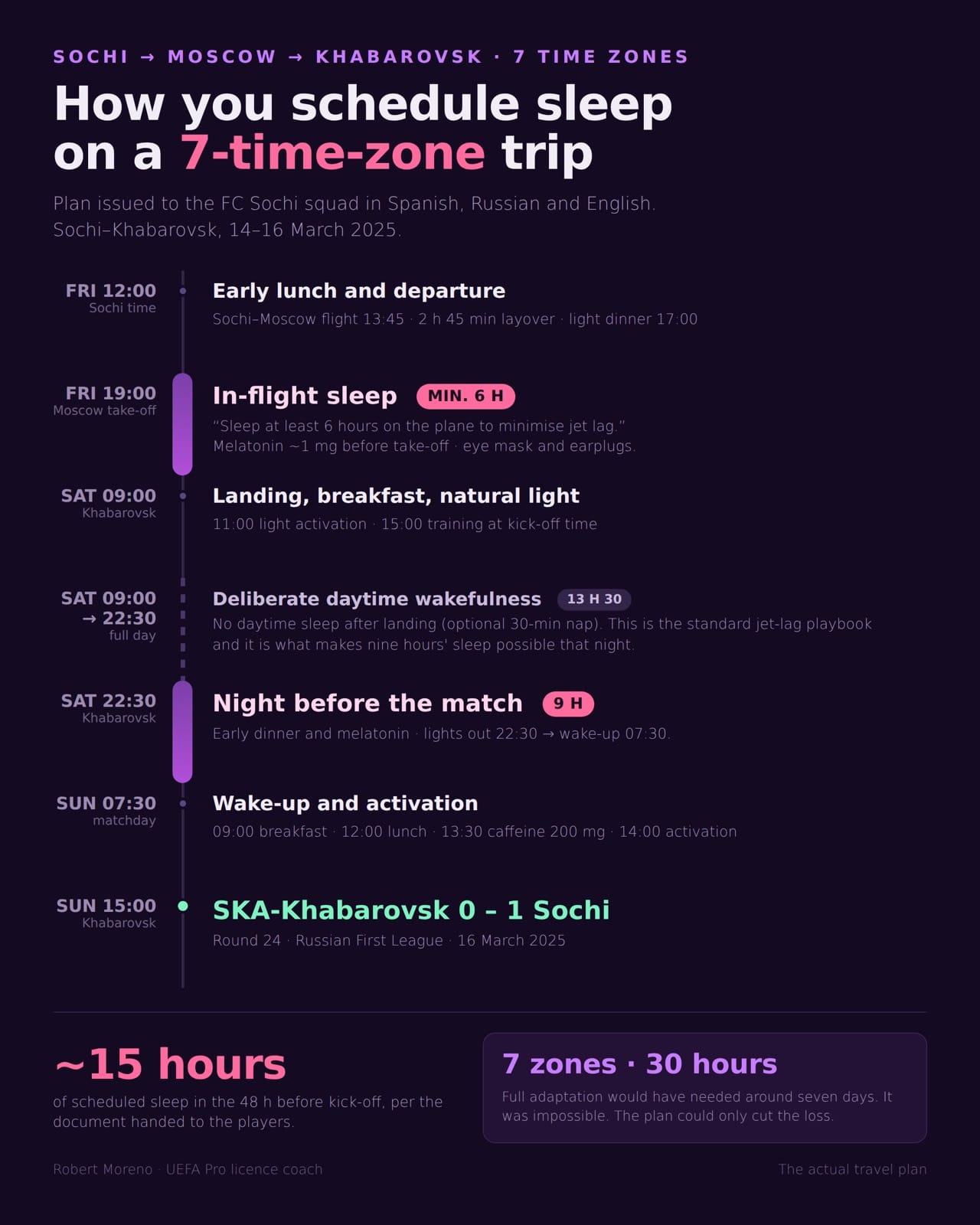
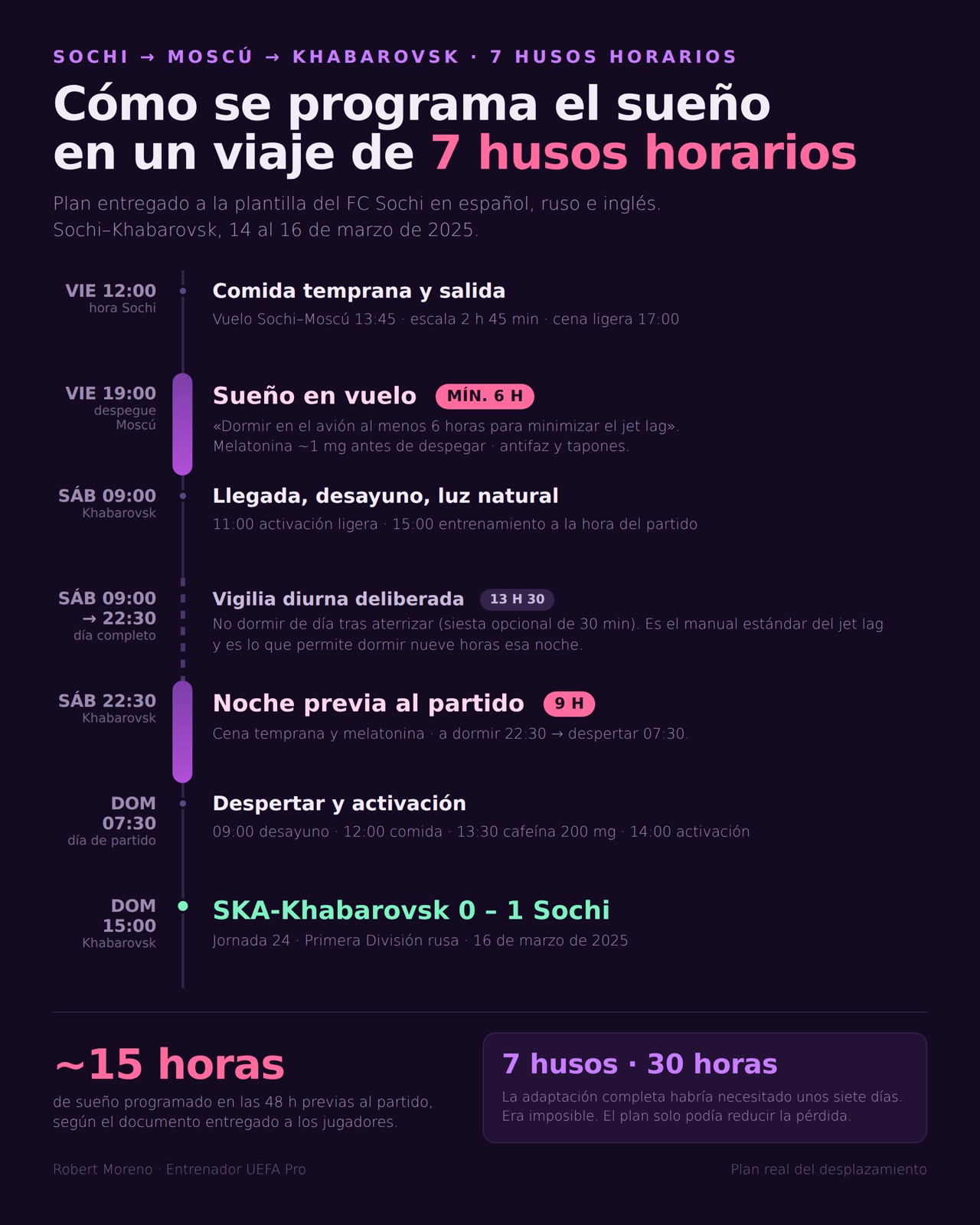
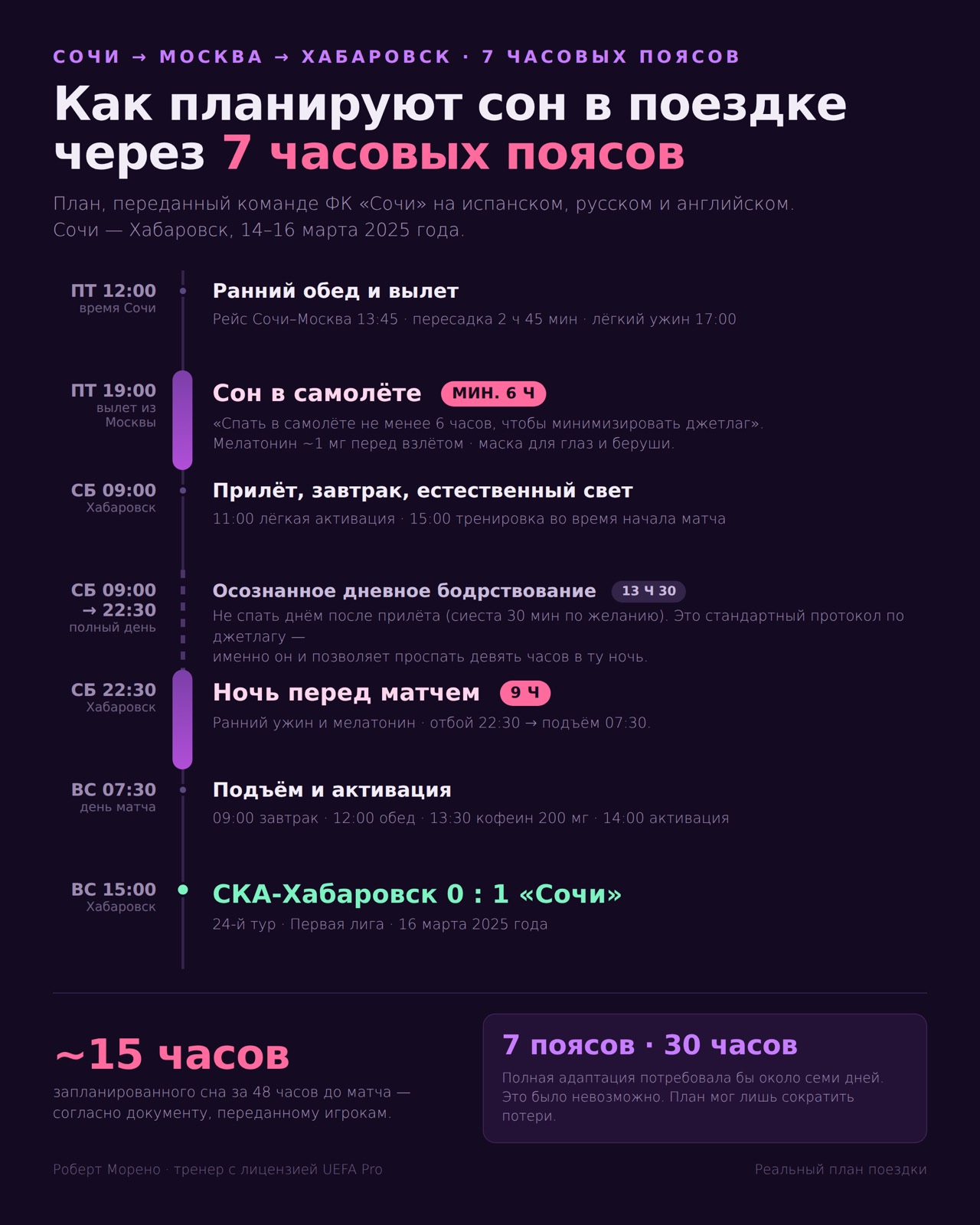
This is what the squad received.
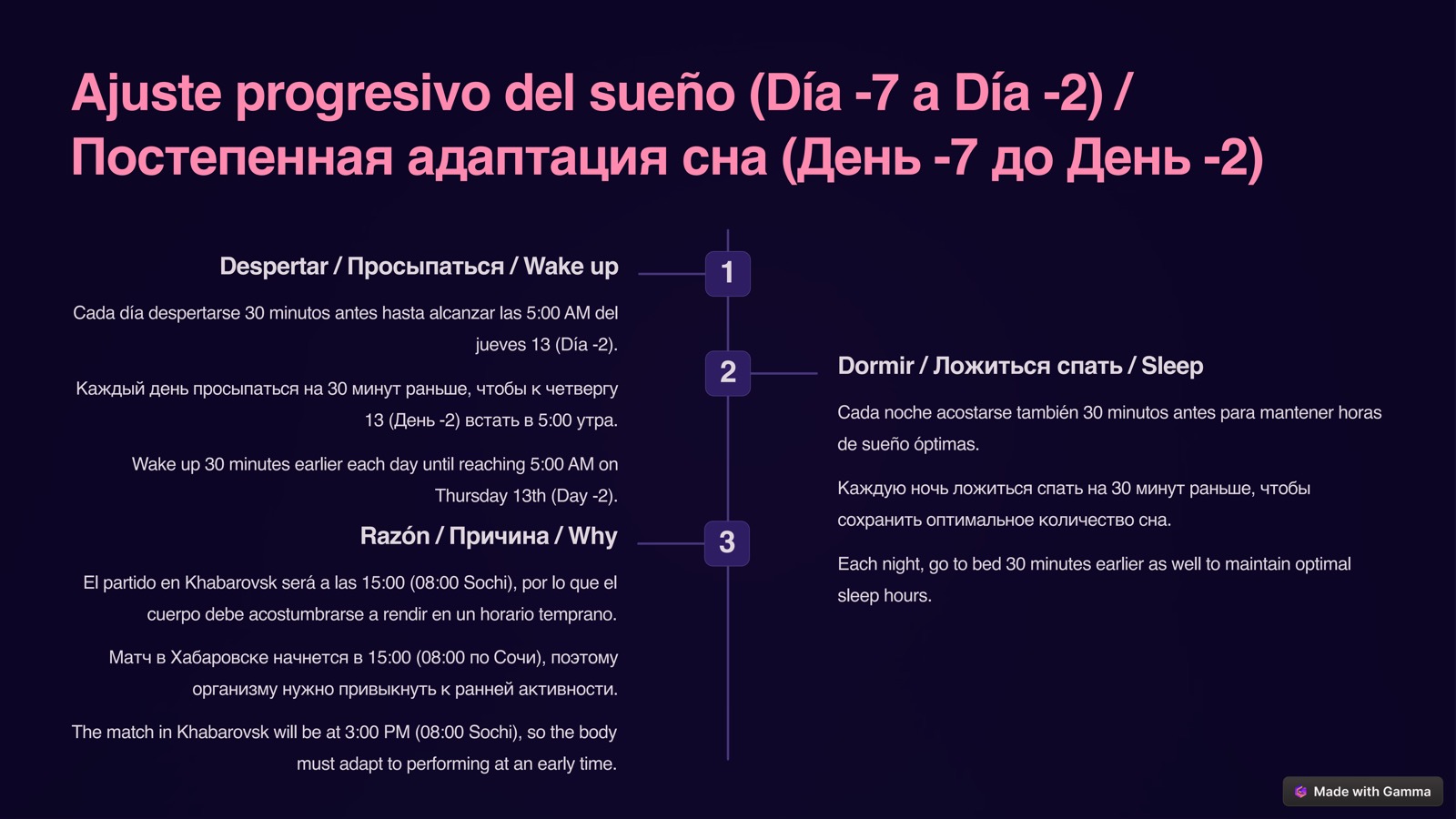
Shift the whole day, gradually. Wake up 30 minutes earlier each day, until 05:00 on the Thursday. And go to bed 30 minutes earlier each night — the document says so in as many words: “to maintain optimal sleep hours.” Sleep is not cut; it is moved. Meals shift with it (breakfast 05:00–06:00, lunch 12:00, dinner 17:00–18:00), natural light in the morning, screens out at night, and low-dose melatonin (0.5–1 mg) from Day −5. Training moved to 08:00 Sochi time so the body learns to compete in that window, and physical load reduced from Day −5: the journey is a load in itself.
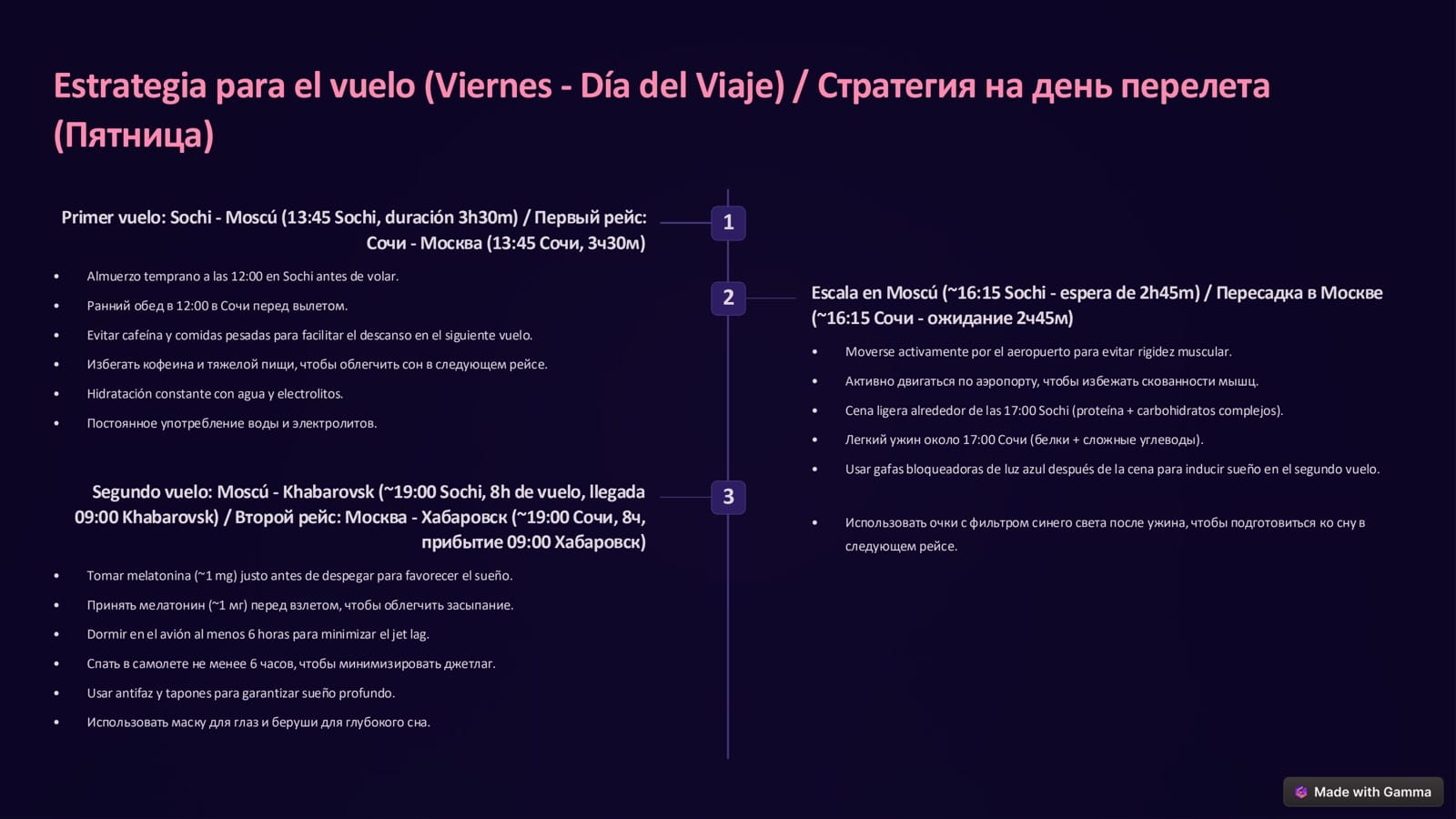
Light morning session. Early lunch at 12:00. During the Moscow layover, walk around the airport and hydrate, and no caffeine and no heavy food “to make it easier to rest on the next flight.” Light dinner around 17:00, blue-light blocking glasses afterwards. Watches switched to Khabarovsk time before boarding. Melatonin ~1 mg immediately before take-off, eye mask and earplugs. And the central instruction of the whole trip: sleep at least 6 hours on the plane.
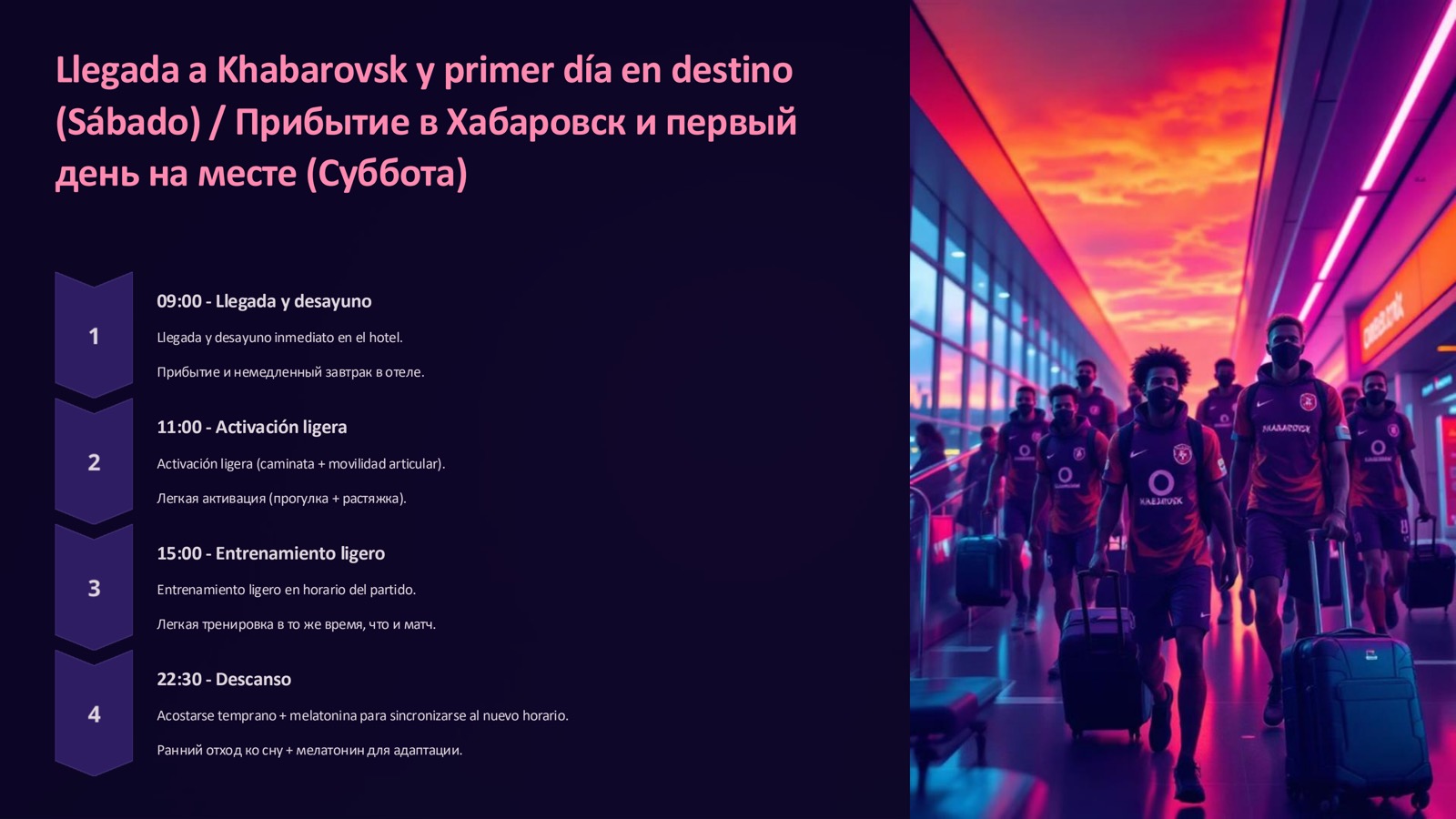
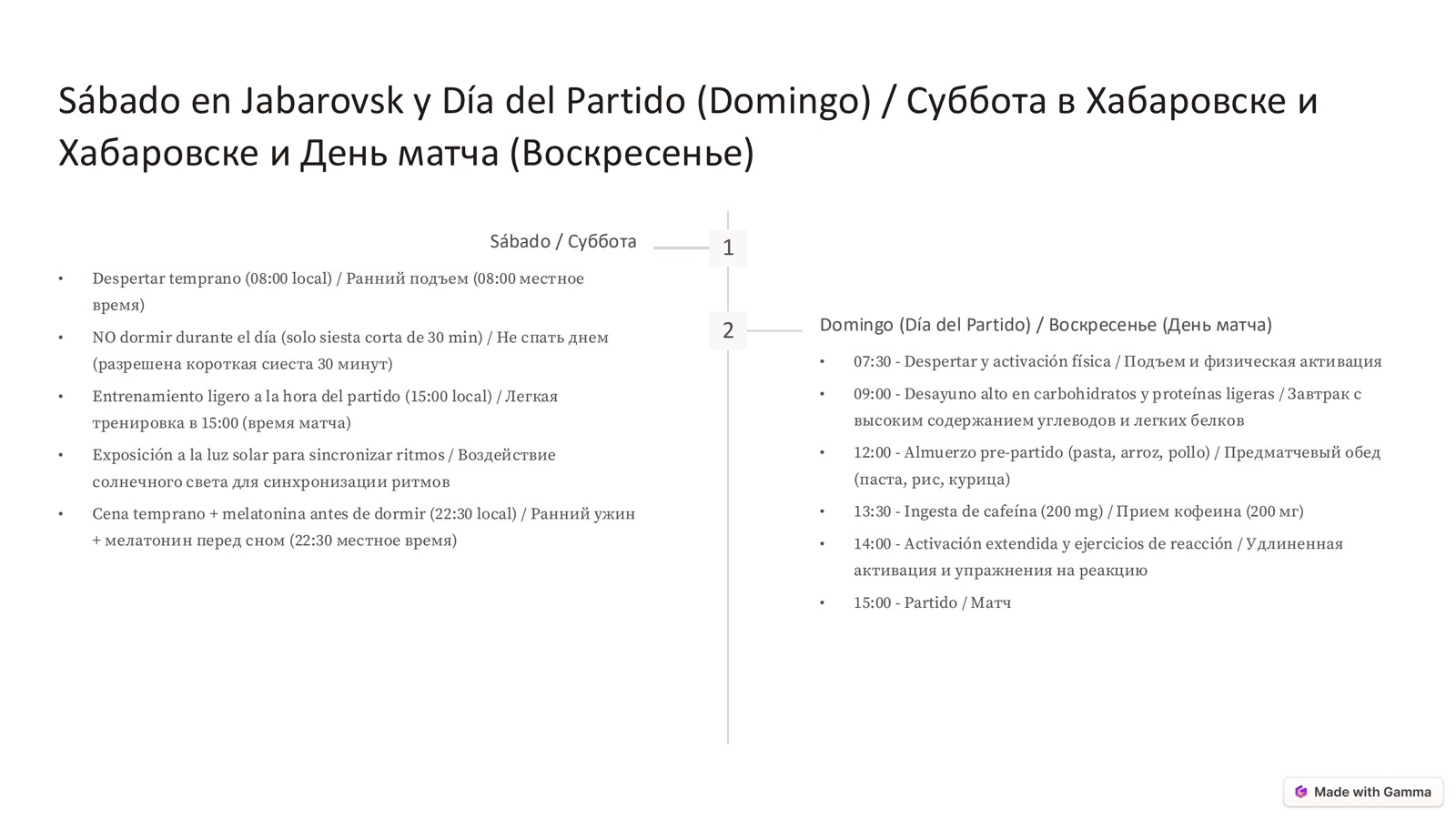
Landing at 09:00 and breakfast immediately. Natural light as soon as possible. 11:00, light activation. 15:00, an easy training session at the exact kick-off time. No daytime sleeping beyond one optional 30-minute nap. Early dinner, melatonin, and lights out at 22:30.
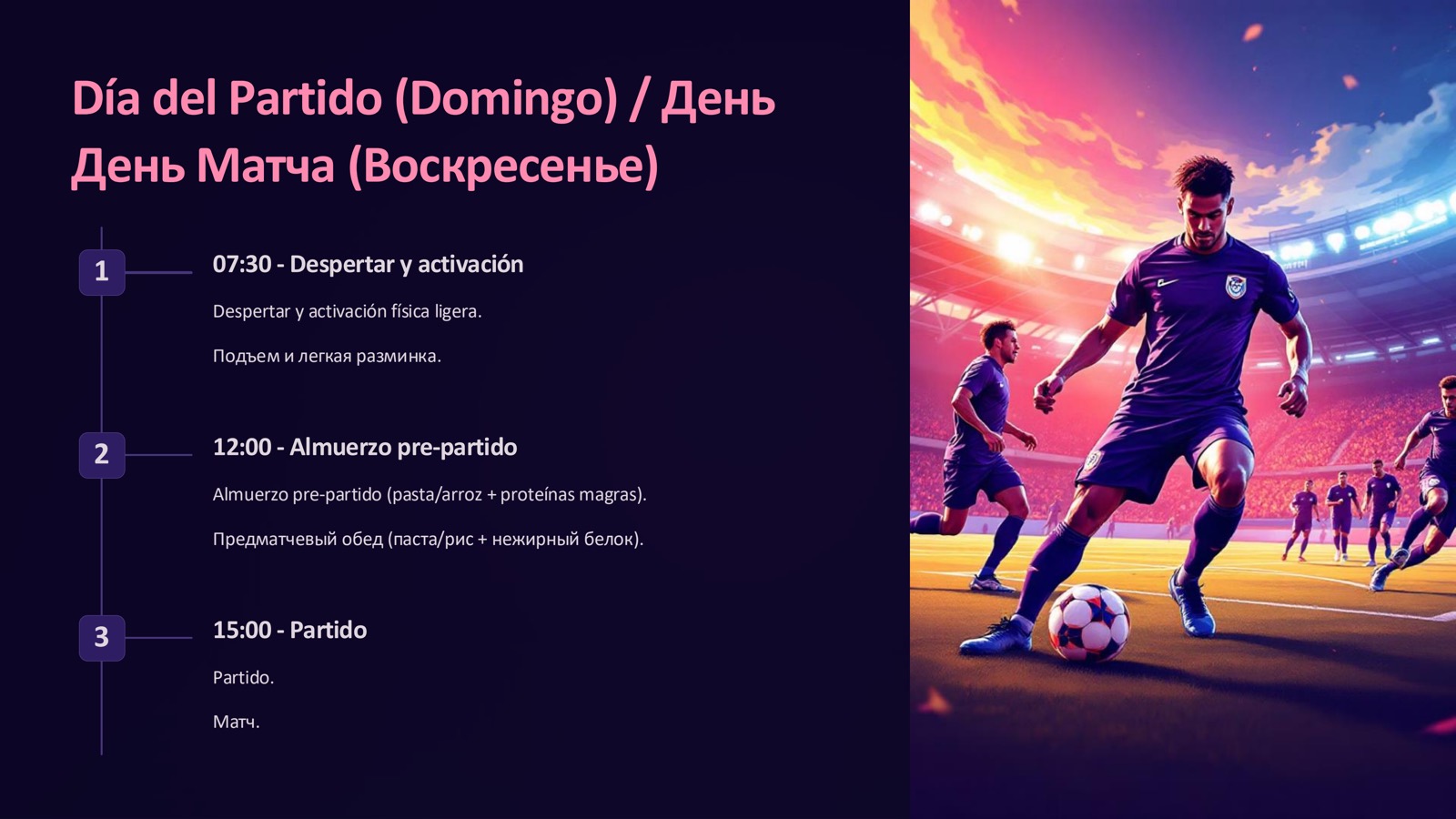
Wake at 07:30 and light physical activation. Breakfast 09:00. Pre-match meal 12:00. Caffeine (200 mg) at 13:30, so the peak arrives with the first whistle. Extended activation and reaction work at 14:00. Kick-off 15:00.
05The three decisions people question most
Of everything above, three things tend to jar with anyone who has not made a trip like this. They are worth explaining, because they hold up the rest.
Why you sleep on the plane rather than on arrival
We flew overnight deliberately. Eight hours in a darkened cabin is the cleanest block of sleep you will get on the entire trip: it is the only way to skip time zones without paying for them in wakefulness. That is why everything around it is engineered — light dinner, no caffeine, blue light blocked, melatonin before take-off, eye mask and earplugs — to protect that block. It is the most repeated instruction in the whole package, appearing twice in the presentation, in all three languages.
Why you do not sleep during the day on Saturday
This is the hardest one. You land at nine in the morning after a night flight and every instinct tells you to go to bed. If you do, you have lost the trip: you wake in mid-afternoon, you cannot sleep that night, and you arrive at the match worse off than if you had done nothing at all. So you ride the day out: light, movement, meals on local time, and at most a short thirty-minute nap. Awake from 09:00 to 22:30 — thirteen and a half hours, an ordinary day for an ordinary person. It is not a punishment. It is precisely what makes nine hours’ sleep possible that night, and that night’s sleep is where the next day’s performance comes from.
Why you train at kick-off time
Saturday’s 15:00 session was not about load; it was about teaching the body that this is the hour to be in competition mode. It also let us get a feel for the pitch, the weather and the light. It was short and easy. Its value was not physical, it was chronological.
06What you cannot control, and it is worth saying so
It would be dishonest to present this as an exact science.
With seven time zones and thirty hours, complete adaptation is impossible, and no plan achieves it. The most you can aim for is to cut the loss.
The response is highly individual. Some players sleep eight hours sitting upright on a plane; others do not close their eyes. Some tolerate melatonin well; others wake up groggy. That is why the plan carried margins — optional naps, minimum doses, individual calls — and why the staff has to keep asking, player by player, throughout the trip.
And there is no way to know how much of it worked. You cannot make the same journey twice, with and without a plan, and compare. We won 0–1 in Khabarovsk, but it would be dishonest to present that result as validation of anything: one match does not validate a protocol. The only thing I can state with confidence is that it was approached with judgement, in writing, using the best available information — rather than boarding the plane and hoping.
07What I took away from that trip
Three things, and they apply to any coaching staff facing this:
- Start seven days out, not on the day of the flight. Almost everything you gain, you gain in the preceding week, by shifting the whole day little by little. By the time you board, most of the work is either done or no longer possible.
- The plan has to fit on one page and be in the player’s own language. Everything else is internal documentation. The quality of a travel plan is not measured by how comprehensive it is, but by how much of it the squad remembers at six in the morning in an airport.
- Do your homework, then decide yourself. Searching well is cheap and faster now than it has ever been. But no search knows your squad, your flight, your fixture list or your doctors. Information is looked up; decisions are made, signed, and answered for.
Closing note · on the reports published in January 2026
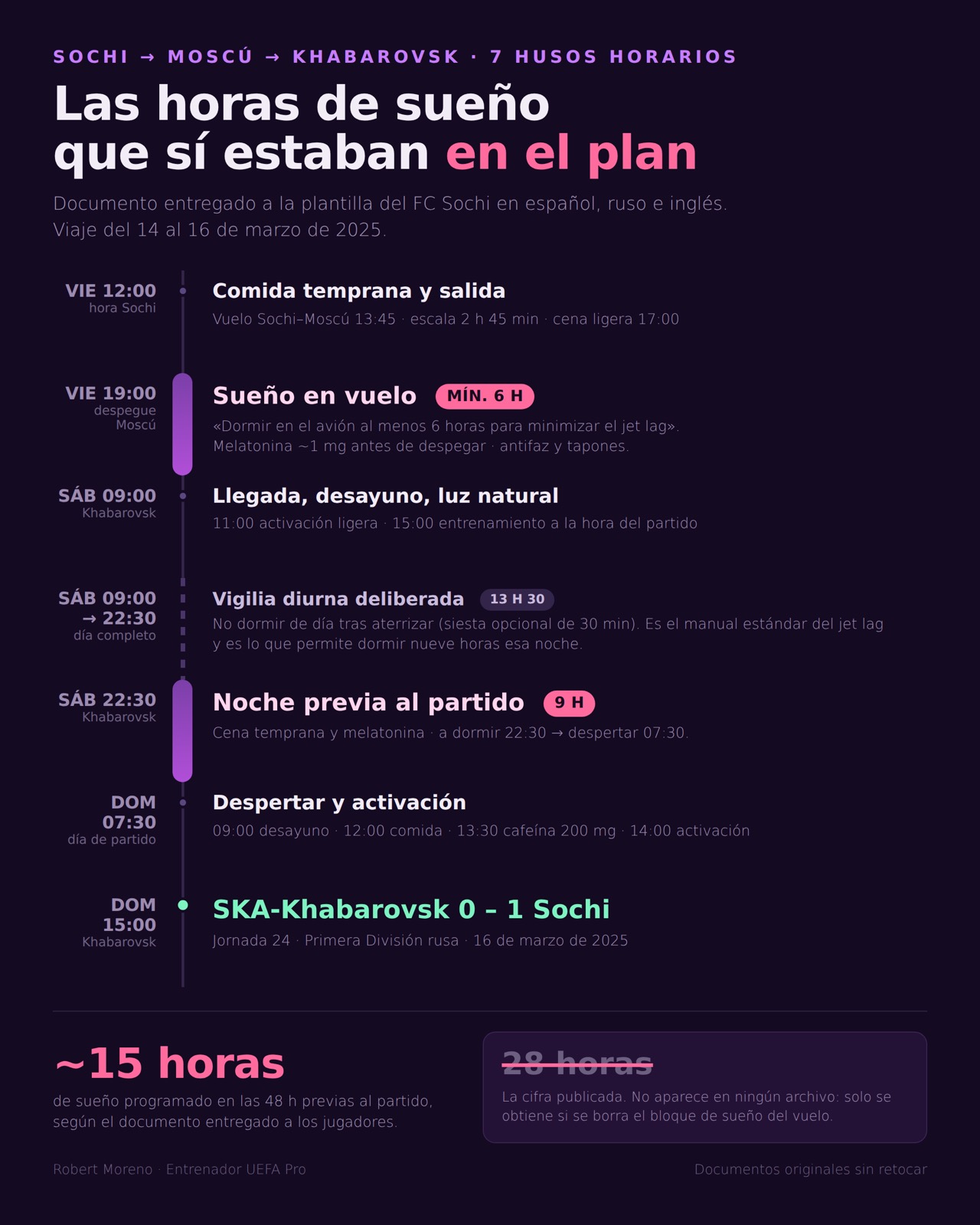
I include this note because since January 2026 it has been reported in several countries that on this trip players were ordered to stay awake for 28 consecutive hours. The figures below come from the same material described above, issued to the squad in February and March 2025 in Spanish, Russian and English.
The plan ring-fences two protected sleep blocks between leaving Sochi and kick-off:
| Block | What the document prescribes |
|---|---|
| Moscow–Khabarovsk flight | at least 6 h (the internal report says 6–7) |
| Saturday night in Khabarovsk | 9 h · 22:30 → 07:30 |
| Total prescribed in the final 48 h | ~15 h of sleep |
The only instruction to stay awake is Saturday’s, explained in section 5: 09:00 to 22:30, thirteen and a half hours — which is what any transmeridian travel protocol recommends, and what makes nine hours’ sleep possible that night.
None of these files contains an instruction to remain awake for 28 hours.
On the use of artificial intelligence: as set out in section 2, the literature search was carried out with the search tools available, AI tools among them. It is a normal and openly stated part of the method, and to my mind the odd thing would be the reverse — taking a professional squad across seven time zones without having looked up what is known about it.
Anyone wishing to check any of these figures is welcome to contact me. The slides are available to any journalist who would like to see them.